Building Practical AI Agents
Published revised 5 min read
When I build an AI workflow, I start with the artifact it needs to produce and the check that will accept or reject it. The loop needs to:
- produce an artifact (a summary, a report, a PR),
- verify it against explicit criteria,
- and revise until it’s acceptable, exhaust a budget, or stop with a visible reason.
That structure lets me inspect a failed run and distinguish generation, tool, and verification failures.
TL;DR
- Make the loop explicit:
draft -> verify -> revisewith a max revision budget. - Verify against something concrete: schemas, checklists, citations, invariants, or policy gates.
- Log state transitions and the reasons for revisions. “It got better” is not a debug strategy.
- Treat tools as untrusted I/O: timeouts, retries, and bounded outputs.
- Preserve an explicit
unverifiedoutcome. Returning the last draft is not the same as approving it. - Keep the agent state visible to operators. If work, blockers, and memory are opaque, the system will feel smarter than it is.
Context: what “reliable” means here
I am not using “production agent” to mean autonomous in every situation. I mean a workflow that can be inspected and operated like a service:
- inputs and outputs have contracts,
- expensive or risky actions have gates,
- retries have budgets,
- tool failures retain enough context to debug,
- and the final artifact carries its verification status.
That last point is easy to miss. A system can produce useful work after a verifier times out, but it should not quietly relabel that work as approved.
The loop matters more than the model
I choose the model within a workflow that already defines inputs, outputs, and stop conditions.
When an agent is reliable, it is usually because the control structure is boring:
- the input shape is constrained,
- the output artifact is inspectable,
- verification is explicit,
- retries are bounded,
- and failure is visible.
That pattern works whether the artifact is a summary, a docs patch, a deployment plan, or a directed acyclic graph (DAG) run in an operator UI.
Here is the smallest useful version. This graph is the optional summarizer path in News Analyzer, trimmed only for space:
class SpecState(TypedDict):
    task: str
    draft: str
    verified: str
    needs_revision: bool
    revision_count: int
    max_revisions: int

def _build_graph(self):
    workflow = StateGraph(SpecState)

    workflow.add_node("draft_step", self.draft_node)
    workflow.add_node("verify_step", self.verify_node)
    workflow.add_node("revise_step", self.revise_node)

    workflow.set_entry_point("draft_step")
    workflow.add_edge("draft_step", "verify_step")
    workflow.add_conditional_edges(
        "verify_step",
        self.should_revise,
        {"revise": "revise_step", "end": END}
    )
    workflow.add_edge("revise_step", "verify_step")

    return workflow.compile()
The point is not LangGraph specifically. The point is that the behavior is a state machine instead of an improvised conversation.
The current implementation also exposes an important limitation: after the revision budget is exhausted, it returns the last draft. That is a reasonable availability fallback for a news summary, but callers still need an approved, unverified, or failed status if the distinction matters downstream.
Current examples from my stack
This pattern now shows up in a few different places across the projects on this site:
1) News Analyzer: the pipeline is the product
The News Analyzer, a 2025 experiment that simulates its pipeline in the browser, is the most literal example. It is an agentic content pipeline:
- collect inputs,
- extract content,
- draft a summary,
- enrich or verify,
- and deliver an artifact.
That is useful because the artifact is concrete and the pipeline stages are visible. You can inspect where it failed instead of treating the whole system like magic.
2) Loom Core: agent work becomes observable
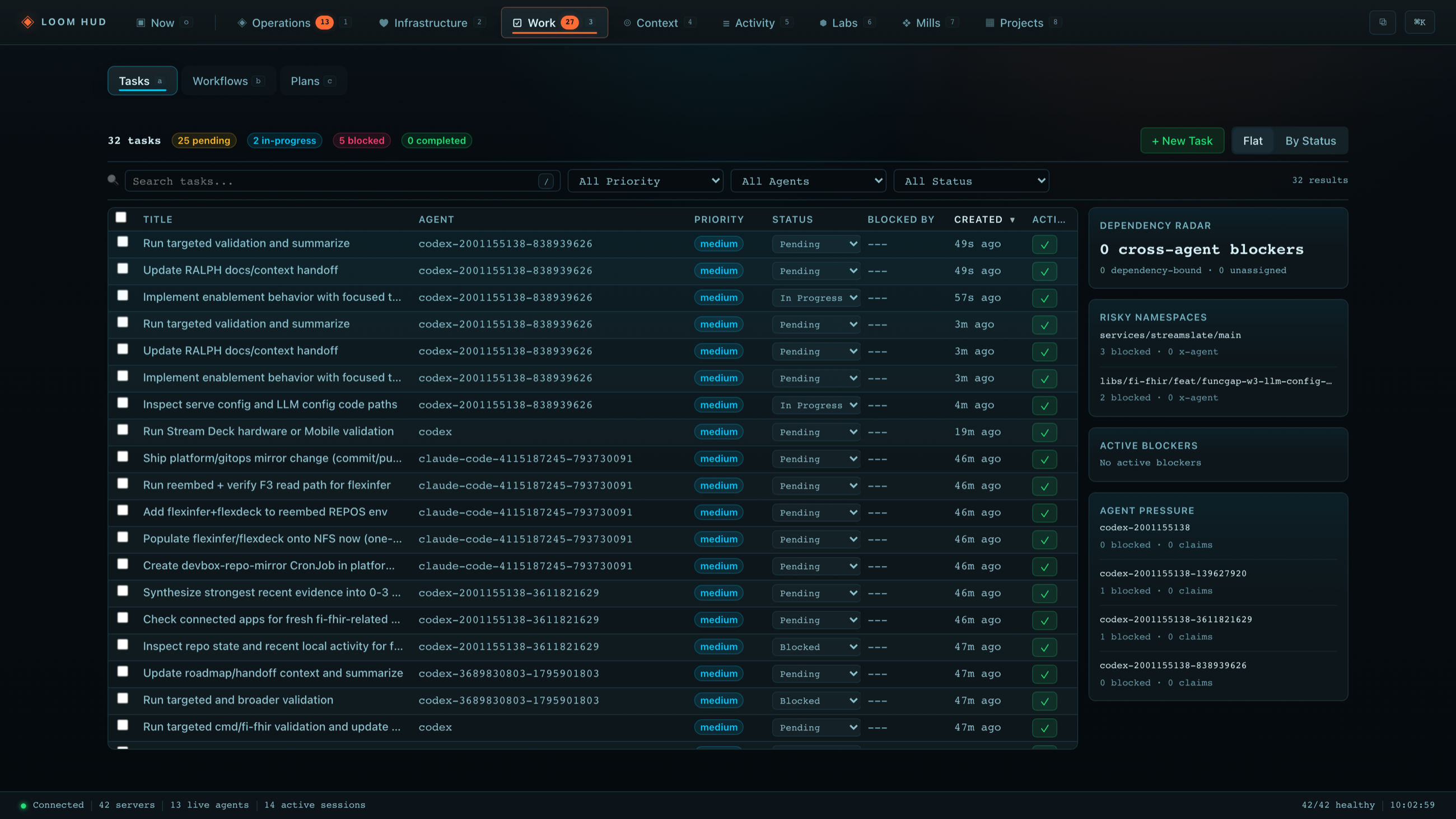
Loom Core’s heads-up display (HUD) shows sessions, tasks, memory, workflows, and server health in one place.
That matters operationally. Once agents touch repos, infra, or long-running workflows, you need to know:
- what the agent believes it is doing,
- what is blocked,
- what tool is slow,
- and what decision was recorded.
Without that, the agent may still be productive, but it won’t be trustworthy.
3) MentatLab: orchestration is an operator surface
MentatLab takes the same core idea and puts it in an operator-facing DAG workflow surface. That is a very different UX from a chat window, but the reliability pattern is the same:
- explicit steps,
- clear handoffs,
- visible state,
- approvals where needed,
- and an artifact at the end.
If a system affects real workflows, I want to be able to point at the graph and say where the risk lives.
Verification is the gate, not the epilogue
The reliability gain comes from the verification step. In the News Analyzer example, a second model checks the draft and either approves it or returns revision feedback.
def verify_node(self, state: SpecState) -> SpecState:
    """Quality verification using orchestrator model."""
    response = self.verify_model.invoke([
        SystemMessage(content="Review this draft. If acceptable, output APPROVED. If issues, output REVISE: <feedback>"),
        HumanMessage(content=f"Task: {state['task']}\n\nDraft:\n{state['draft']}")
    ])

    if "APPROVED" in str(response.content):
        return {"verified": state['draft'], "needs_revision": False}
    return {"needs_revision": True, "verified": str(response.content)}
This is enough to demonstrate the control loop, but it is not the verifier I would use for a high-stakes workflow. The approval parser is a substring check, the rubric is embedded in a prompt, and the terminal state does not preserve a distinct unverified result.
For a stricter system I would return a typed verdict, validate it against a schema, record the rubric version, and keep verification failure separate from content failure.
The verifier does not need to be an LLM every time. In good systems, verification is often cheaper and stricter than generation:
- JSON schema validation
- required citations
- contract checks
- diff review rules
- policy or RBAC checks
- bounded retries with a hard stop
Approval needs an explicit result that callers can validate and retain.
What I instrument now
If I expect an agent to do real work, I want enough telemetry to debug it like a service:
- state transitions
- revision count and revision reasons
- tool latency and failure rate
- artifact size and validation failures
- stop conditions and timeout reasons
This is also why I like bounded tools and visible task queues. When the artifact is bad, I want to know whether the problem was the model, the tool, the policy, or the workflow design.
Many “agent” products are retrieval-augmented generation (RAG) pipelines with a nicer UI. That can still be useful. But it is a different control structure. The practical distinction for me is simple:
- if the system can verify and revise against explicit criteria, it starts to behave like an agent,
- if it only retrieves context and generates once, it behaves like a generator with better inputs.
Takeaways
Concrete practices that held up across these projects:
- Start simple: small state + small tools beats a mega-prompt.
- Make the artifact inspectable: summaries, plans, PRs, tickets, and DAG steps are easier to debug than vibes.
- Test with real tasks: synthetic tasks hide the failure modes you care about.
- Be honest about models: model size does not repair an ambiguous gate. Start with a narrower rubric and a typed result.
- Keep operator state visible: HUDs, task lists, traces, and workflow graphs are not polish. They are safety features.
- Keep fallback state honest: a usable draft after a verifier outage is still unverified.
Related examples:
Related posts
10 min read
State of the Platform, July 2026
A July 2026 platform snapshot: multimodal inference, Mills delivery, flight recording, and the operational gaps that remained after the demos worked.
Shared tags: loom-core · mentatlab · agents
6 min read
Repo Design Patterns for AI-Assisted Dev: Control Loops, Hooks, and Memory
Treat the repository as a control system: versioned instructions, explicit workflows, fast hooks, durable context, and visible failure states.
Shared tags: agents · loom-core · workflows
16 min read
A Green Run That Checks Nothing: Seven Silence Modes, Seventy Repos, One Day
A fleet-wide maintenance day exposed seven ways CI can report success without useful work—and the merge-queue discipline and recurring checks built to catch them.
Shared tags: loom-core · agents
Comments
Join the discussion. Be respectful.